

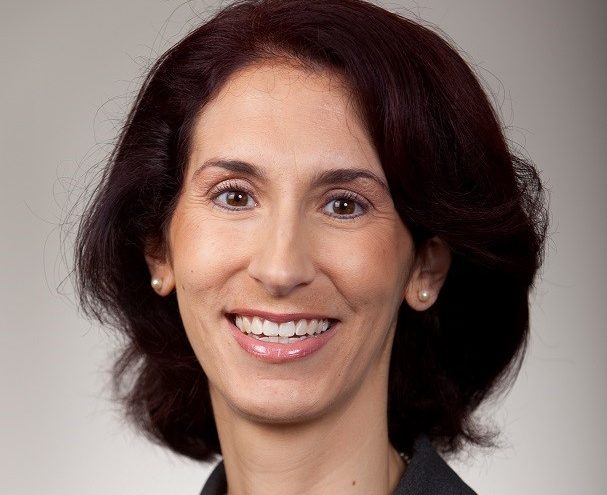
Mentorship has been a throughline in Dr. Adriana (Adri) Tremoulet’s career, first as a young physician-scientist finding her footing in academic medicine and now as a faculty-development leader helping others do the same. Early in that journey, support from the Harold Amos Medical Faculty Development Program (AMFDP), now the Amos Institute for Medical Faculty Development (AIMFD), helped her continue building her research career while connecting her with mentors who would remain influential well beyond the award period.
Today, Dr. Tremoulet is a professor in the Department of Pediatrics at UC San Diego, a pediatric infectious disease physician, and Assistant Vice Chancellor of Faculty Affairs for Health Sciences. Her work spans research on Kawasaki disease, the most common cause of acquired heart disease in children, and other pediatric inflammatory syndromes. She is also deeply involved in faculty development, where the mentorship she experienced through Amos continues to shape how she supports other physician-scientists.
“When I think about the Amos fellowship, there’s a word that comes to mind, and it’s ‘transformational,’” Dr. Tremoulet says. “There are multiple career development awards through different foundations and institutes, but I think that what distinguishes the Amos program is the mentorship, and that is what makes the program transformational.”
The Amos award came at a formative point in Dr. Tremoulet’s career, as she was establishing herself as an independent investigator and working toward promotion from assistant to associate professor. Her fellowship director encouraged her to seek guidance from a previous Amos awardee at UC San Diego, who helped her prepare for the application and interview process. With Amos support, Dr. Tremoulet pursued research focused on diagnostic test development for Kawasaki disease. Her network also grew to include mentors through her home institution and the Amos National Advisory Committee (NAC), now the Scientific Advisory Group of Experts (SAGE).
“There’s such a deep level of understanding that it’s a lifelong two-way road with this award,” Dr. Tremoulet says. “When situations arise that require mentorship, especially a voice outside of your own institution, it’s very comforting and very unique to know that you have access to that quality of mentorship.”
Dr. Tremoulet has long referred to the Amos community as the “Harold Amos family,” a reflection of how different those mentoring relationships felt. Academic medicine can sometimes feel isolating, and Amos gave her a community that understood both the successes and struggles of the work. The candor of the NAC members was an important part of creating that sense of connection.
“I can’t overstate the privilege of being in the presence of the NAC members,” Dr. Tremoulet shares. “They were incredibly honest and willing to have very frank conversations with us, which required a level of vulnerability that is unusual to see in senior faculty. They shared both their successes and their struggles. It was very relatable.”
As a Latina, Dr. Tremoulet already felt a strong pull to mentor others like her. One NAC member’s advice helped her see that advancing her own career would ultimately give her greater capacity to support others.
“One of the NAC members said that you could only help those below you when you had actually climbed the academic ladder,” Dr. Tremoulet says. “It was both a warning not to burden yourself too early and a charge to remember that once you get high enough on the academic ladder, you reach down and help those on the lower rungs.”
Today, Dr. Tremoulet continues to carry that model forward by helping others pursue the Amos program and by supporting junior faculty as they advance in their careers. For her, that ripple effect is part of what makes the Amos community so powerful: Scholars learn what strong mentorship looks like, then carry those lessons into the way they support others.
“What transforms academic medicine the most is having that understanding of what good mentorship is,” Dr. Tremoulet says. “It’s the old motto of medicine: ‘See one, do one, teach one.’ You see what good mentorship is, then you become a good mentor, and then you teach someone else how to become a good mentor. Amos Scholars feel a responsibility to be good mentors, to teach good mentorship, and to become sponsors and advocates.”
We invite you to invest in the Amos Institute for Medical Faculty Development and the leaders who are expanding life expectancy, strengthening communities, and shaping health policy across the country. Support AIMFD by making a gift today.