

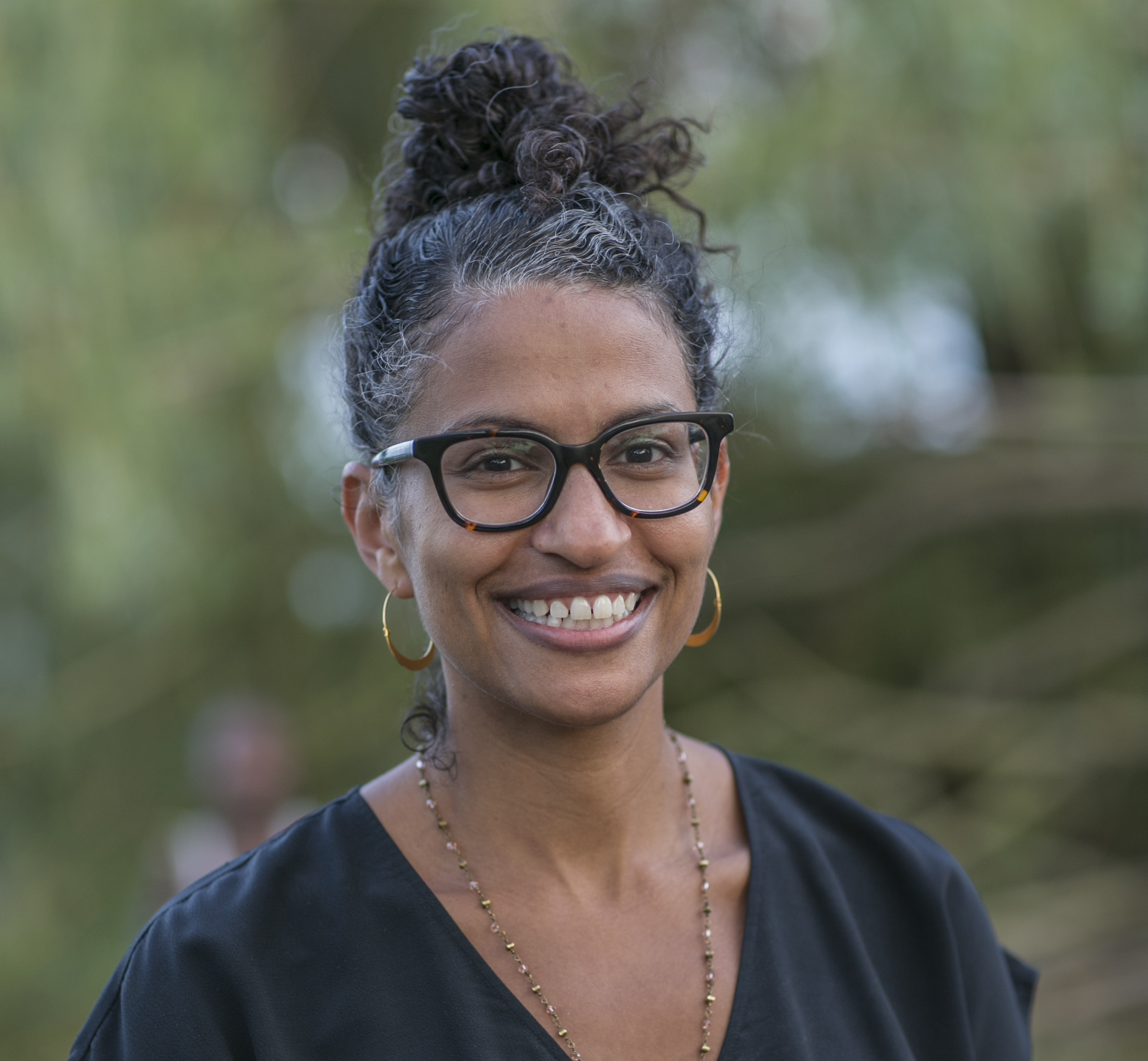
Dr. Eugenia South did not set out simply to study health. She set out to change the conditions that shape it. A physician-scientist at the University of Pennsylvania, Dr. South is an alum of the Harold Amos Medical Faculty Development Program (AMFDP), now the Amos Institute for Medical Faculty Development (AIMFD). Her work focuses on how neighborhood environments influence safety, stress, and long-term health outcomes, particularly in Black communities. It spans research, community action, and health system transformation, including Deeply Rooted, a community collaborative rooted in her research on the health benefits of urban nature, building on her Amos-supported research The Nature and Wellbeing Project.
“Deeply Rooted is a community-academic collaborative that leverages the healing power of nature to promote health and safety in Black Philly neighborhoods surrounding Penn,” Dr. South says. “Over the last three years, with over 26 community partners, we’ve greened over a million square feet of vacant land, planted over 1,000 trees, and we’re building eight community co-designed miniparks, turning vacant spaces into small green spaces community members can use everyday.”
The minipark model builds on Dr. South’s Amos research, where she first explored how transforming vacant land into green space can improve community health and safety. Now entering its next phase with support from the William Penn Foundation, Deeply Rooted reflects the kind of real-world impact that Amos-supported scholars can achieve. In fact, Dr. South traces much of her path to becoming a nationally recognized physician-scientist and elected member of the National Academy of Medicine to the support she has received through AMFDP.
“This award is not just money, it’s community,” she says. “The funds to support your research and protected time are vital, but what’s most impactful is the community and the relationships. The Amos program has been a real touchstone of community that I can build around me.”
Dr. South first applied to AMFDP in 2018 as a junior faculty member at Penn Medicine pursuing a career development award but was not selected. With encouragement from mentors including J.A. Grisso and the late Sandy Schwartz, she applied again in 2019 and was accepted. Dr. South joined a cohort of Amos scholars across disciplines and institutions, and that mix of perspectives quickly formed a network that extended beyond the program itself.
“Amos is a professional network that’s unrivaled,” she says. “It’s people from all different fields—basic science, clinical trials, health services research, population research—doing all different kinds of research, but at similar stages in their careers. I’ve become really close with members of my cohort, both personally and professionally, and we are still in communication with each other all these years later.”
The AMFDP Annual Meetings also played a defining role in Dr. South’s trajectory. Designed to bring scholars together for professional development and cross-disciplinary exchange, these gatherings often sparked unexpected opportunities. At the 2019 Annual Meeting, Dr. South attended a session on social media.
“At the time, I was not on social media at all, and I asked why, as an academic, I should be on social media. Two scholars gave such compelling answers that I created an account the next day,” she recalls. “I can directly link social media with an explosion of my research that helped me build a national reputation. It became a really important tool in my career that I would not have used if it wasn’t for that annual meeting.”
Beyond individual career advancement, Dr. South describes the Amos program as a space for shared experience and understanding among scholars navigating the complexities of academic medicine. That sense of belonging has been especially important as she has advanced in a field where representation remains limited.
“Having a group of rising leaders who share similar life experiences is invaluable,” she says. “In academia, there are so many challenges I have had to navigate being a Black woman, and there are very few spaces where I can be with people who truly understand and have lived those experiences. One of the legacies of Amos is ensuring paths for underrepresented scientists to not just succeed, but to thrive and become leaders in the field.”
During her time as an Amos scholar, Dr. South secured a multi-million dollar NIH grant along with colleague Dr. Atheen Venkataramani for a large-scale randomized trial testing how combined environmental and economic investments in Black neighborhoods can address systemic barriers and improve health outcomes. Now more than a decade into her career, Dr. South has gone on to lead multiple federally funded studies, publishing widely cited research on neighborhood health, and advancing community-based interventions at a national scale.
“I really have achieved outstanding success earlier than one would think,” she says. “There are a couple of key ingredients to that success, but definitely being part of the Amos program has been one of them.”
Dr. South’s journey reflects the lasting impact of the Amos program. By investing in scholars, building community, and creating pathways for leadership, AIMFD continues to shape the future of medicine and the health of communities nationwide.
We invite you to invest in the Amos Institute for Medical Faculty Development and the leaders who are expanding life expectancy, strengthening communities, and shaping health policy across the country. Support AIMFD by making a gift today.