
To maximize health outcomes for everyone, healthcare must be researched, designed, and delivered by those who understand the unique needs of the people and communities they serve.
We must attract and retain providers who can best serve patients from all walks of life. The Amos Institute for Medical Faculty Development strives to support and develop medical and science leaders who reflect their communities to advance biomedical sciences, transform healthcare for all, and inspire and mentor the next generation.
Today we are:
- Identifying and engaging future leaders,
- Providing them with opportunities for career development,
- Supporting their innovation in biomedical and healthcare research, and
- Building a community that pays it forward through leadership, sponsorship, and mentorship.
We invite you to be a part of this mission.
Together, we can shape a more inclusive, innovative, and impactful future in healthcare.
AIMFD Today
How is the Amos Institute for Medical Faculty Development (AIMFD) different from the Harold Amos Medical Faculty Development Program (AMFDP)? AIMFD has much broader eligibility than the AMFDP in several ways.
Learn more about our transition from AMFDP.
Training
In addition to MDs, DOs, DDS, and Nurse Scientists, we welcome applications from PhDs in basic science and public health with or without clinical training who do research and work in medical settings.
Science
We’ve expanded eligibility to include applications with projects in public health.
Background
We welcome applications from all who feel that they may not have access to the kind of mentored research training program that the AIMFD offers, based on their background and lived experiences.
Learn More About Us
AIMFD By the Numbers
Our scholars draw from 36 states plus DC and include former presidents of the American Heart Association, American Society of Hematology, American Society of Nephrology, American Gastroenterological Association plus more.


About Harold Amos, Ph.D.
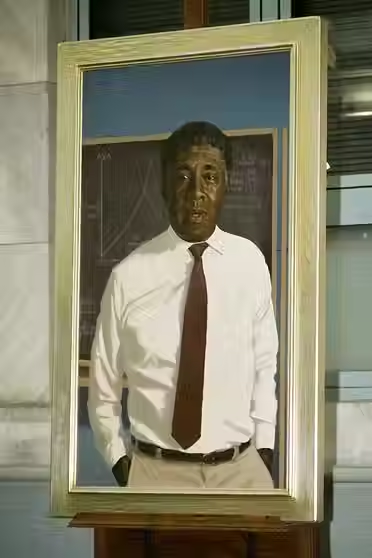
Harold Amos, Ph.D., was a pioneering scientist and educator who dedicated his career to advancing academic medicine and biomedical science. He was deeply committed to mentoring students and supporting their paths into research and academic leadership. In 1983, he became a founding member of the National Advisory Committee for the Minority Medical Faculty Development Program (MMFDP), later serving as its National Program Director from 1989 to 1993. In recognition of his extraordinary contributions, the program was renamed in his honor in January 2004 and is now known as the Harold Amos Medical Faculty Development Program. He remained actively involved with the program until his passing in February 2003 at the age of 84.
Academic and Professional Legacy
Dr. Amos earned his undergraduate degree summa cum laude from Springfield College in Massachusetts and completed his Ph.D. in Microbiology at Harvard in 1952. He was the first African American to earn a doctoral degree from the Division of Medical Sciences at Harvard Medical School. Following a Fulbright Fellowship at the Pasteur Institute in Paris, he joined the faculty at Harvard Medical School, where he served for nearly five decades. During his tenure, he was the first African American to chair a department, now the Department of Microbiology and Immunobiology. In 1975, he was named the Maude and Lillian Presley Professor of Microbiology and Molecular Genetics.
His research focused on bacterial metabolism and both animal and bacterial virology. Beyond his work with the Robert Wood Johnson Foundation, Dr. Amos contributed to the missions of the Josiah Macy Jr. Foundation and the American Cancer Society. His many honors included the Dr. Charles R. Drew World Medical Prize, election to the Institute of Medicine, and fellowship in the American Academy of Arts and Sciences.

A Life Beyond the Lab
Dr. Amos was known not only for his scientific achievements but also for his warmth, curiosity, and wide-ranging interests. He was a friend to people of all ages and backgrounds, and he cherished meaningful conversation. A lifelong Francophile, he preferred handwritten notes over email, traveled by train and ocean liner, and had a deep appreciation for art, literature, and fine food.
He collected works by emerging artists, spent hours in antiquarian bookstores, and embraced new technologies—on his own terms. His generous spirit and gentle nature continue to inspire those who knew him and guide the ongoing mission of the program that bears his name.